• AFTERWORD

    AFTERWORD

    A Found Poem in Memory of Anthony Bourdain

    I will always carry my heart around, my entanglements
    a big room free of country, and most certainties.
    My dreams travel in strange beauty, telling me what to do —
    if I can relax or drink in fully, or if I have been comforted.
    Beyond normal human itinerary, I don’t know absolutes.
    Painful complexity — like a lot of wonderful nothing —
    perfectly telling my way, after years, where and when.
    Life still rules me. It says something, I think,
    that I’m untormented by the cigarette, I don’t really
    enjoy talking shit, I’m at home in the kitchen. I make
    people skills every day, most relaxed when being nice.
    I’m magnificent alone. I once knew a nice orderly life.
    I’m less sure anymore, since upwards of ten or eleven
    nights a month felt a mystery, somewhere southeast
    of an Asia I don’t know, or a city lounge, a smoking
    background — the Muzak there honest, four or five
    complications I’ve had playing innocuously,
    having maybe already captivated. I thought I knew the rules:
    in-out-of, aren’t-weren’t, either-way. Live anywhere, man,
    make a home, do my best full time, fully coming
    from ‘safe’ adjustments. For one reason or another since,
    maybe I’ve already told myself what to do: Be without,
    challenge myself, relax in other months. Enjoy I don’t
    know. So. Though human, behavior anymore, as it were,
    has left the airport — a New-York-to-Asia-
    twenty-eight-plus days of the year. On one hand, good;
    all aren’t outside chefs. The particular world, then, remains
    about true, and there at ease — another kitchen to me.

    -Laura Scheffler Morgan, 11/28/18

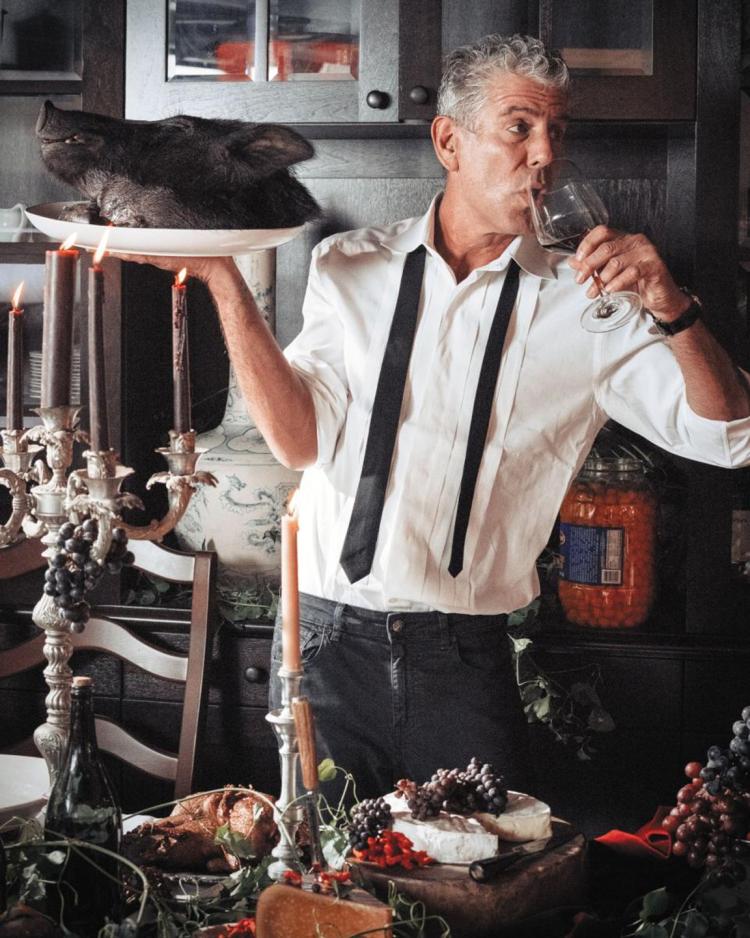
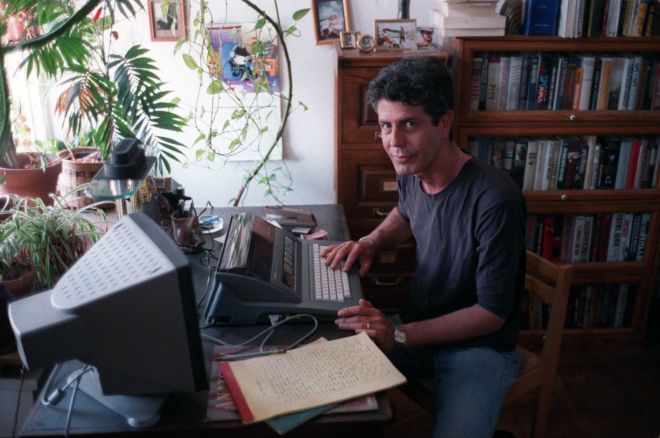
    I wrote the above found poem in honor of Anthony Bourdain and his singular way of reaching people, whether or not he had obvious connections with them. I am one of those people he reached. I wrote the poem using only words from the following excerpt:

    I don’t really live anywhere anymore, already a man without a country. I’m home – maybe – four or five nights a month and travel, for one reason or another, upwards of ten or eleven months out of the year. So maybe I’ve already left. Though I will always carry New York City around in my heart, I don’t know if I can fully relax and enjoy living there full time anymore, having been captivated in strange and wonderful ways by Asia, Southeast Asia in particular. I don’t know if I can relax and fully enjoy myself there either, to be perfectly honest. I once felt ‘safe’ and at home in the kitchen. I knew the rules – or thought I knew the rules. It was a life of absolutes – of certainties – and that comforted me in a way nothing since has. Like a lot of chefs, I’m less sure of myself outside the kitchen. Since all my dreams came true, I’ve had to make adjustments. I have to make them every day. My people skills – beyond telling them what to do – or being told what to do – and talking shit – weren’t the best after twenty-eight-plus years in The Life. They still aren’t. It says something about me, I think, that I am most at ease these days – at my most relaxed – when alone in the smoking room of an airport lounge, coming from somewhere nice and on my way to another. Muzak playing innocuously in the background, a nice orderly itinerary in one hand – telling me what to do, when to do it and where – a drink or a cigarette in the other… and I’m good. I’m free, as it were, of the complications of normal human entanglements, untormented by the beauty, complexity and challenge of a big, magnificent and often painful world.

    Human behavior remains a mystery to me.

    – Anthony Bourdain, Bali, 2006, from the Afterword of Kitchen Confidential, Updated Edition


  • HONEY OUT OF THE ROCK

    14207683_10154001730427499_7362875698015719666_o

    HONEY OUT OF THE ROCK

    I need to live like that crooked tree — / solitary, bittersweet, and utterly free — / that knelt down in the hardest winds // but could not be blasted away. / It kept its eye on the far horizon / and brought honey out of the rock. – Green Figs by Edward Hirsch

    Tonight, in my current
    kitchen, handmade wooden
    cutting board on the counter
    holding early home-grown tomatoes,
    the small but intensely sweet
    fruit I’ve spent the summer so far
    saving — from transported
    beetles, insects with almost
    no predator — I feel a temporary
    calm. The kind that’s only
    calm after suffering, no matter
    how minute. I mean I’m turning
    46; it feels like things are upside-
    down, I say, folding my tissue
    in miniature, a demure square
    so even my pains are intentional,
    collected, tidy: I put bows on things.
    I’m looking for the next place
    to be in between, that’s as far
    as I’ve gotten; the next
    Temporary. I want a place to Be.
    The sun is setting stirred coral
    smoke outside the kitchen window.
    The past few summers,
    I’ve grown a backyard garden
    outside this window, right in front
    of the sunset. I knew I’d see
    the first garden through;
    I’d signed a year’s lease.
    The last couple I wasn’t as sure
    where I’d be at the end of the season,
    but still I planted similarly.
    This summer, I dug another garden,
    tomatoes and sunflowers
    in the ground, but, this time, hoping
    I’d be leaving soon, I also
    placed sunflower seeds in patio pots:
    I’ll take some flowers with me.
    The garden-rooted sunflowers
    have approached their height more
    slowly than the potted companions,
    but they’re much heartier than my
    transportable crew. I want them all
    to thrive. I want to transplant the potted
    flowers to the ground, even if,
    because that means they’ll stay
    here, no matter where I am.
    But I’ve taken up all the space
    that’s for now mine to take.
    So I take care of the grounded
    and portable gardens, knowing
    as I must have known all along,
    that the work is worth missing
    any kind of harvest; because maybe
    knowing something temporary is
    as permanent as anything gets.
    This, my garden, has always,
    has never, been mine. And I know
    it will explode in golden kaleidoscope,
    in window-high heights of joy,
    for bright-striped goldfinches to dine,
    singing, on the bowing flowers.

     
    -Laura Scheffler Morgan 7/26/18

  • TITANIC REVISITED

    titanicatdock

    TITANIC REVISITED

    You won’t find bodies…. You won’t find skeletons…. What anybody who’s explored the wreck finds is pairs of shoes. – James Cameron, discussing 20 more years of research after the movie, Titanic

    The camera shows a pair of women’s
    shoes, a pair of girls’ shoes, a hand
    mirror. A clock, once only thought
    to be resting on a cabin mantle,
    is now pictured; it was real.
    The grand staircase has traveled
    in the deep; its oak dense,
    but architecture, physics, denser.
    The ship remains divided. This we
    knew. But study since submits
    more lifeboats may not have saved
    more souls. With a timely knife,
    the filmmaker relays the slow
    release of a boat, the wait
    before lowering one atop
    another. Still, he regrets the frozen
    floating faces, knowing ancestors
    of them since. He could’ve been
    more sensitive. Every pair of shoes
    I think I hear him say. Such
    classic shoes: to me they look
    like not one night’s but many years’
    shoes. The camera closes in once
    more. The silted ocean floor balances
    one man’s dress shoes, leather
    once treated and still preserved
    with tannic acid. His bones long ago
    turned solution. — That pair of shoes
    reached the bottom on a person.

    -Laura Scheffler Morgan 12/14-18/17; 3/18-20/18

  • DWELLED PLANET

    IMG_0087a
    Interstate 70 West


    Dwelled Planet

    I thought at one point, if you could be up in heaven, this is how you would see the planet. And then I dwelled on that and said, no, it’s more beautiful than that. This is what heaven must look like. I think of our planet as a paradise. We are very lucky to be here. – Astronaut Mike Massimino


    Few people have watched
    decades in perspective,
    deep and peeking from history’s
    star-studded sea, or seen
    the sun shrink til at one point
    it was human: rarified
    and alone in very thought
    of what heaven could be.
    Fewer face a wristwatch
    easily, see that curved
    horizon as a bulk-24 growing
    in the gravity. No, it’s more
    beautiful smaller, I must think.
    Bound by inescapably
    precious orbit and biology,
    most of us can’t step outside
    here into space-flight. Cut off
    from distance, the rocketed
    view from our Earth-side
    paradise is nearly impossible, only
    we cosmic people larger than life.


    -Laura Scheffler Morgan 3/7/18

    This poem is a Found Poem, using only words, rearranged, from the above opening quote and first paragraph of National Geographic’s article, ‘Beyond the Blue Marble’ by Nadia Drake, which appears originally as follows:

    For the bulk of human history, it’s been impossible to put Earth in cosmic perspective. Bound by gravity and biology, we can’t easily step outside it, above it, or away from it. For most of us, Earth is inescapably larger than life. Even now, after nearly six decades of human spaceflight, precious few people have rocketed into orbit and seen the sun peeking out from behind that curved horizon. Since 1961, a mere 556 people have had this rarefied experience. Fewer, just 24, have watched Earth shrink in the distance, growing smaller and smaller until it was no larger than the face of a wristwatch. And only six have been completely alone behind the far side of the moon, cut off from a view of our planet as they sailed in an endlessly deep, star-studded sea.

    28870684_10155728021337499_3808311342033534976_n


  • EARLY FOR SPRING

    DSC_0241

    Early For Spring

    Seems like it happens each winter: I wake
    one morning and hear spring. Too much
    light in sound, in winged singing
    and commotion, a clarity in the air
    released from previous melted muting
    snow. Focus and intention I’m not yet
    ready for, now, early February.
    What stirs me most each time I wake
    this way is how my reaction startles me –
    In April, grasses and flowering weeds
    overtaking fields and bare spots
    beneath mailboxes will thrill me. Storm
    clouds spotlighting citrine branches,
    henbit’s royal flush. The last two winters,
    at least one day was warm enough
    to sunbathe, so, in my fenced yard
    I placed my beach towel, books, sunglasses,
    first thinking, This is marvelous.
    But the yard is zoysia, and winter turns
    it a hollow thirsty remnant of gold,
    the tree limbs are lonely, dragon-
    and damsel-flies are missing, bees
    nowhere prowling for buried flowers.
    The sun, see, is missing most
    of her praisers. The Midwest has taught
    me timing; to learn things too early
    is the hard way. This too early morning
    there is still time to grow into that lit window
    before it opens, into this dehydration
    that must be quenched before it is thirsty.

    -Laura Scheffler Morgan 2-7-18


  • MAGIC TREE

    DSC_0473 (2)

    MAGIC TREE

    We’re wrapping lights around the Maple.
    Tightly, so when night alights outside

    we won’t see a cloud, but the tree,
    her gracious, spreading skeleton.

    When you mention that across the street,
    earlier, Steve hung his decorations —

    icicles framing his roof — I remember
    you’ve already told me this. I didn’t grasp

    until now, making small circles
    around the branches, that Steve can’t see.

    His effort astounds me: climbing
    his ladder — owning a ladder,

    finding it, placing it under the roof
    in one spot rather than another — holding

    a glowing strand above his head, his eyes
    blind to what his hands do.

    Steve won’t see the house he brightens
    for his wife, his children who visit,

    his grandkids, the neighbors. But he
    knows a similar vision, maybe

    from childhood, outside and cold
    before dinner, Dad proud on the ladder,

    Mom outside to check progress,
    petting the dog’s brow, pulling on mittens.

    My vision blurs imagining any of this:
    the joy presence knows, well after eyes

    stop seeing anything in front of them.


    -Laura Scheffler Morgan, 12/6-10/17

  • DOORSTEP

    Tonight, four years ago, I almost tripped over a tiny kitten on the garage step. For some well-timed reason, I looked down before I stepped, and two large, dark, highlighted eyes and a milk-drop nose turned up toward me. Long story shortened, the kitten adopted me, and I adopted him. Since I’d been watching a Pearl Jam documentary when I met him, I named him Eddie. Days later, I nicknamed him Eddie Cheddar, and sometimes lately when he’s being particularly silly, I rub his chin and call him Ed.

    Today kicks off a several-day annual holiday celebrating the joys of life with Eddie. When I walk into the living room, he surprises me with his MC Hammer sideways jumping slide. He races me into the office, jumps on top of the desk chair so he can be my height. He lunges like Kramer through a doorway. Almost every day, Eddie lets me bathe him. He enjoys trying some of my dinners, even dishes too sophisticated for some kids.

    Eddie is really, really adept at letting me take care of him, and more, appreciating that care. He finds every warm sunny or bedtime lounge spot I make for him. He curls up, squints and smiles and rolls upside down, his paws flopping in relaxation, white belly a mess of furry vulnerability. He relishes his cozy safety.

    But four years in, Eddie is still terrified of strangers. Each doorbell ring and door knock spurs a sudden dog-like growl, and sometimes a tear through the house. He hides on a closet shelf behind my clothes. Although I’m sad he gets frightened, I want him to be comfortable in there, so I’ve covered the shelf with linens. I part the clothes and pet his forehead, reassuring, “It’s just you and me now, bud. It’s just us.”

    I’ve known all along that Eddie was abandoned as a kitten. “Someone left him,” the vet suggested when she met him and assessed his health. He was a bit beat up and malnourished, and his bobcat ears were full of mites, but he was fine to take home for good. The longer, though, that Eddie is afraid around most people other than a slowly growing few, the more I think when he was a kitten, he was not just neglected, but abused.

    I doubt I’ll ever know where Eddie came from or how long he was on his own out with the owls and hawks and coyotes, the Halloween Night crammed cars, yelling kids, and leaping flashlights. Or what happened to him in the company of people before his time in the wilderness. He was two months old when I met him; those two months are a mystery.

    I marvel that regardless of those two months, Eddie trusted me to care for him within hours. And he has since learned to trust and play with others. I’m thankful every day that he’s happy, peaceful, and zany, and that he cares for me. I’ve loved all the animals called pets I’ve chosen since childhood. Eddie is the first pet I didn’t even consider, let alone plan for. But the instant he found me, he lit me up. I was ready to take care of him. One lesson this year as I celebrate, then, is clear: Joy, when it finds a doorstep, no matter where, is a gift, a call to nurture, to feed what makes it thrive ‒ to not just let joy in, but take really, really loving care of it.

    ‒ Laura Scheffler Morgan, 11/1/2017

    IMG_6379

  • WHISKEY-PROOF

    DSC_0034.JPGa

    Here’s a poem I wrote more than several years ago around this time of year. I’m sharing it in honor of St. Patrick’s Day.


    WHISKEY-PROOF

    Not because I need its deep heat, or mindful spice −
    it’s not replenishing I want but something more

    potent, bottled up and dangerous − to singe
    the sweetness I’ve got in cluttered abundance, busted,

    swollen heart-caged, admitting all your tired
    and glazed, soul exhibits Z-A. Lined up, the doses sing,

    perfect portions of measurable suffering, one song,
    each shot: I know, I know, I know. The bartender

    does, also. She fields pain, nightly eases each of us
    to ideal heart rate, zoned in lone, loaned longing.

    Bar-side, her grain-hued mane soothes light behind
    our small translucent glasses, color of what will

    be alternative, alternate − darker, honeyed, smoked
    and riotous. And this is where we enter, us, fair and raven

    drinkers − students, really, my friend says − taps his glass
    on the battered bar, an amber capsule held anxious

    in toast’s glint pause, I’m just a damn student,
    knowing nothing’s more desiring than grasping there’s forever

    still to learn, in relentless spilled vessels, dosage’s burn.


  • ARROWS

    Arrows
                                                                                                                            internet

    We are what we eat, we know; but more, we are what we feed ourselves. This pertains to far more than food. Our surroundings are our fuel. Our family members, people we befriend, people we love, what we read, watch, listen to, where we live, where we travel, what we run into and what we plan, how we suffer and celebrate, what we choose to ignore, what and how we appreciate ‒ and, yes, what we eat ‒ all of it is how we feed ourselves. If we occasionally take a step away from it all to get a more reasonable view, that step can be calming, jarring, somber, frustrating, or rewarding, but it’s often helpful.

    Feeding works both directions. Say I take a step back, and feel one of the above emotions. I’m not the only person or creature in my environment. How I feed myself also feeds others. And how others feed themselves feeds me. We are all inter-related. No one celebrates or grieves alone. No one suffers by herself or is angry by himself. Unless we are hermits, living alone for years with no human contact, our emotions and our choices affect each other.

    I’m not standing on a soapbox, here. I’m kneeling in the dirt far beneath a soapbox. But it’s okay; I like dirt, and dirt feeds me ‒ of course, ultimately actually ‒ but also, I just appreciate it. Dirt is where things that are no longer growing collect and accumulate so that what’s growing now can thrive. Dirt is the past, present, and future. It’s messy, and it’s basic, and it’s complicated, and it makes magic real. Dirt is calming, jarring, somber, frustrating, rewarding, and it is helpful. Dirt, life, is still and in constant motion.

    From this grounded vantage point, all the ways we feed ourselves seem almost other-worldly. All kinds of relationships, our apartments and condos and cabins and house boats and houses, our pets, how we make any of them home, our books, TV shows, movies, how we interact when we’re together or connecting in and around wires or wavelengths: all of it suddenly seems so complex and even futuristic.

    Thinking this way is an exercise I’ve given myself today while reading Thich Nhat Hanh’s book, “No Mud, No Lotus: The Art of Transforming Suffering.” The premise is that without mud, which is suffering, a lotus, which is happiness, can’t grow. While the sensory experience of the mud may be unpleasant to some, that mud produces a flower that creates highly pleasurable sensations. The point is that we can cultivate happiness from suffering. More, that happiness can’t exist without suffering.

    So if ‒ when ‒ one steps back and assesses one’s surroundings, one’s fuel, and finds any suffering, that pain doesn’t need to last. It is the ingredient needed to start making happiness. Not just individual but collective happiness:

    If we take care of the suffering inside us, we have more clarity, energy, and strength to help address the suffering violence, poverty, and inequity of our loved ones as well as the suffering in our community and the world. If, however, we are preoccupied with the fear and despair in us, we can’t help remove the suffering of others. There is an art to suffering well. If we know how to take care of our suffering, we not only suffer much, much less, we also create more happiness around us and in the world.

    That’s hard to do, especially in a tough spell. Keeping suffering brief and in control is rough stuff. But the following Buddhist teaching, called “The Arrow,” helps get through that quagmire:

    It says if an arrow hits you, you will feel pain in that part of your body where the arrow hit; and then if a second arrow comes and strikes exactly at the same spot, the pain will not only be double, it will become at least ten times more intense.

    The unwelcome things that sometimes happen in life… are analogous to the first arrow. They cause some pain. The second arrow, fired by our own selves, is our reaction, our storyline, and our anxiety. All these things magnify the suffering.

    It seems to me, then, that we can each be aware of how we feed and receive, and how we construct and direct our arrows. Stopping to think and read today made me stop firing the second set of arrows. Once I took a step back, I found a book that helped me look at the ways I’ve fed myself recently, and for much longer. The book helped me achieve distance from a very complicated, basic, grounded place: where I live.

    The reasons for needing to step away can’t possibly ever start and end with only one person. I’m part of multiple different surroundings. Therefore, I’m fed by those and I feed all those places, from the feathered past to the point of the future, which is happiness.

    So, for now, one more thought: From the mud, a lotus is growing. I hope through it you enjoy the earthy, hard-fought, messy environment of wonder and peace. It’s from, and for, you.


  • HE WAS A BRILLIANT GODDAMN HEDGEHOG

    hedgehog

    “We have no idea what we don’t know, or what we’ll eventually learn, or what might be true despite our perpetual inability to comprehend what that truth is.”

    -But What If We’re Wrong?: Thinking About the Present as If It Were the Past by Chuck Klosterman

    That statement might seem gloomy to some, but I find it intellectually exhilarating. It says to me: We can ‒ we get to ‒ learn so much more than we think we know! Klosterman’s idea in “But What If We’re Wrong?” is that our reality can’t possibly be exactly as we perceive it; there might be, and likely are, aspects of our reality construction that we can’t yet even imagine to question, let alone understand.

    He opens the book discussing gravity, summarizing the drastic changes in our understanding of it: from Aritstotle ‒ who “believed all objects craved their ‘natural place… that a dropped rock fell to the earth because rocks belonged on earth and wanted to be there” ‒ to Newton to Einstein to quantum mechanics and string theory and so on. According to the theoretical physicist Brian Greene: “’There is a very, very good chance that our understanding of gravity will not be the same in five hundred years. In fact, that’s the one arena where I would think that most of our contemporary evidence is circumstantial, and that the way we think about gravity will be very different.’” Some contemporary scientists, Klosterman says, “suspect gravity might not even be a fundamental force, but an emergent force.”

    He explains (this information, as huge as it is, exists as a footnote):

    This means that gravity might just be a manifestation of other forces ‒ not a force itself, but the peripheral result of something else. Greene’s analogy was the idea of temperature: Our skin can sense warmth on a hot day, but ‘warmth’ is not some independent thing that exists on its own. Warmth is just the consequence of invisible atoms moving around very fast, creating the sensation of temperature. We feel it, but it’s not really there. So if gravity were an emergent force, it would mean that gravity isn’t the central power pulling things to the Earth, but the tangential consequence of something else we can’t yet explain. We feel it, but it’s not there. It would almost make the whole idea of ‘gravity’ a semantic construction.

    So, what if our current understanding of gravity ends up as footnote in a future definition? That would mean one of our most non-controversial perceptions of how we go about on earth might be off balance. Klosterman asks an obvious and deep-thought-causing question: “If mankind could believe something false was objectively true for two thousand years, why do we reflexively assume that our current understanding of gravity ‒ which we’ve embraced for a mere three hundred fifty years ‒ will somehow exist forever?”

    I ask a similar, broader, non-gravity-specific question all the time, about everything: We’ve been wrong about so much, so why should we think we’re right now? While the constant questioning sometimes shortens my sleep, and lengthens my daydreams, I keep asking. It’s a steady way to progress. We didn’t know, we learned, we think we know, we’ll keep learning, we’ll know more, and so on. I can’t think of a better, more productive, open-minded way to think.

    Klosterman applies the gravity question to many topics throughout the rest of the book, from literature, to television, politics, the movie “The Matrix” (it’s about more than you thought), conspiracy theories (a section that contains one of my favorite lines, “Metaphoric sheep get no love.”), false memories, life after death, the Internet, history itself. Lots of fascinating ideas.

    One of my favorite parts of the book, though, is really simple. It’s a story about when Klosterman lived, after college and before moving to New York, for four years in Ohio. He was writing, drinking, single, and spending some of his evenings on his balcony ‒ watching a hedgehog.

    The view from my Akron apartment faced the back of the building. There was an apple tree in the yard, and the (comically obese) hedgehog would sit underneath its branches and longingly stare at the low-hanging fruit. It often seemed like he was torturing himself, because there was no way a hedgehog of his ample girth could reach an apple two feet above his head. Yet every time he did this, he knew what he was doing. Every time, or at least every time I happened to be watching, an apple would eventually fall to the ground, and he would waddle over and eat it. He was a brilliant goddamn hedgehog. I couldn’t stop thinking about it.

    From what I gather, the hedgehog had learned, probably from sitting under the apple tree many times, that an apple will fall. And when the apple falls, the hedgehog can eat. While Klosterman doesn’t define this story the way I’m about to, I hope it’s alright to take the information and come to some of my own additional conclusions, towards future conclusions.

    Seen one way, the hedgehog has learned to await an upcoming occurrence; he’s learned to anticipate the future. In this sense, the hedgehog represents an appreciation for current knowledge, for information we’ve collected before now, through now. Though we have so much to learn, we can take some temporary comfort in where we stand in the process, if we’ve worked through the process to get here.

    Seen another way, the hedgehog has learned that eventually the present will be the past. This way, the hedgehog represents the place of now in the future. Now is about to stop being now, at least not as it is now. Not to make the hedgehog metaphor too weighty, this simply means, in this case, that to the hedgehog, at some point the waiting will be over. The apple will be in his temporarily satisfied stomach. And then he’ll wait some more, and he’ll keep eating.

    So, what if the apple here is knowledge?

    I think it is, and then I agree. That’s one brilliant goddamn hedgehog.